|
|

|
EMIR Detectors
The EMIR consortium
has decided to use a 2048x2048 Rockwell Hawaii-2 detector. It has already been received at Instituto de
Astrofísica de Canarias (October 2000). It can be seen in the following picture:

(click for a larger view)
This kind of detector is the largest HgCdTe infrared focal plane array in the world. With a pixel
pitch of 18 microns and a format of 2048 x 2048, the total array measures just less than
40mm x 40mm. The HAWAII-2 multiplexer has slightly changed from that of the HAWAII with 3
output modes, finer control of the clocking to improve self- emission "Glow", and circuitry
to reduce crosstalk.
Its main characteristics can be summarized in the following table:
|
Parameter |
Measured Values |
Units |
| Detector Interface Circuit |
SFD |
- |
| Cell Pitch |
18 |
µm |
| Die Size |
<40 |
mm2 |
| Integration Capacity |
1.0x10⁵ |
carriers |
| Integration Capacitance |
18-35 |
fF |
| Signal Conversion Gain |
3.4-6.8 |
V/e- |
| Output Signal Excursion |
.4-1 |
V |
| Minimum Read Noise |
<10 |
e- |
| Dynamic Range |
up to 10 4 |
V/V |
| Maximum Data Rate |
<1 |
MHz |
| Maximum Slew Rate |
400 |
nsec |
| Peak D* @ min Qb |
>1x10¹⁴ |
Jones |
| Power Dissipation |
<2 |
mW |
|
|
In the following picture, you can see the comparison between a NICMOS-3 array (left) and
EMIR Rockwell Hawaii-2 detector (right).
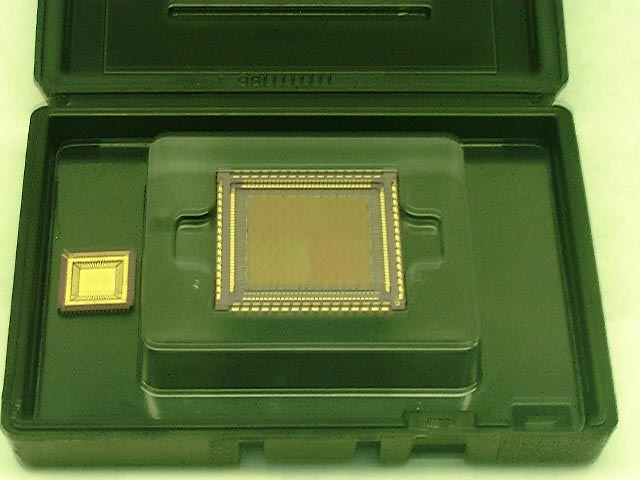
(click for a larger view)
For more information, please visit the official
Rockwell Hawaii-2 Homepage.
|
|


